Frame SVG: Graphics for Crafts Sellers
As someone who’s launched over 200 digital product listings across Etsy, Creative Fabrica, and Shopify—and scaled a small business built entirely on printable design assets—I opened the Frame SVG bundle with one question in mind: Can this help me ship higher-value products faster, without compromising quality or commercial safety?
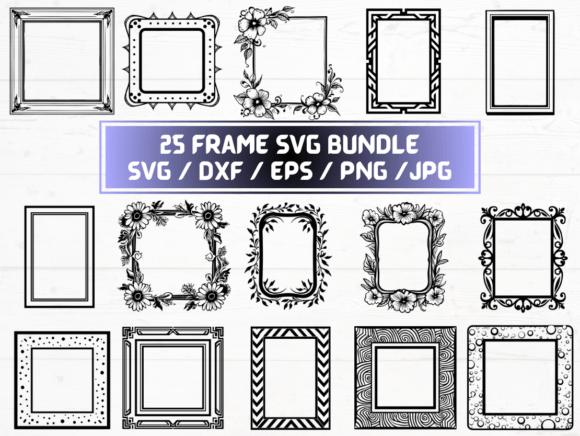
First impression? Clean, versatile, and quietly confident—not flashy, but purpose-built. The frames carry a balanced visual personality: modern enough for minimalist Canva templates, decorative enough for nursery wall art, structured enough for t-shirt layout guides, and refined enough for premium planner sticker sheets. They lean elegant rather than playful, timeless rather than trendy—meaning they won’t date quickly in your shop. That’s critical when you’re building evergreen digital downloads.
I tested Frame SVG across three real product scenarios: a seasonal “Spring Planner Kit” for Etsy, a sublimation-ready “Coffee Lover Mug Bundle” for Printful integration, and a set of editable Canva invitation templates for wedding clients. In each case, Frame SVG served as both functional structure and aesthetic anchor—framing quotes, photos, dates, and product highlights without competing for attention.
Here’s where it shines most:
- Printable design collections—especially wall art, quote posters, and themed planners—benefit from the consistent proportions and subtle detailing in each frame. I used one as a border for a 8x10 printable affirmation card; it elevated the perceived value instantly.
- Cricut project kits rely on crisp, single-layer SVG files—and all 25 included in Frame SVG imported cleanly into Design Space with no stray nodes or overlapping paths. No cleanup needed.
- Sublimation design prep was straightforward: the 300 dpi PNGs held sharp edges even when resized to fit tumblers and totes, and the transparent background meant zero clipping work before uploading to Printify.
- Canva template builders will appreciate how easily these scale and recolor. I dropped one into a social media post template, changed the stroke to gold foil, and paired it with a serif font—done in under 90 seconds.
- Digital download bundles gain cohesion when every element shares visual language. Adding Frame SVG to a clipart pack gave the whole set stronger brand identity—even though the frames themselves aren’t characters or icons.
For product presentation, Frame SVG improves thumbnail appeal immediately. On Etsy, where 70% of clicks happen on mobile, a clean frame around your main mockup image signals professionalism at a glance. I used one as a subtle overlay on my listing banner—it didn’t distract, but made the product feel more curated and trustworthy.
It also supports visual hierarchy in complex layouts: think greeting card templates with layered text, photo collages for baby announcements, or branded packaging design mockups. A frame draws the eye inward, guiding attention exactly where you want it—without needing extra design elements.
But let’s talk realism. Frame SVG isn’t magic—and misusing it can backfire. Avoid dropping it into:
- Tiny sticker designs where fine inner linework gets lost at 0.5” scale.
- Overly dense scrapbooking kits where 25 similar frames create visual fatigue instead of variety.
- Low-resolution print products—like budget greeting cards printed at 150 dpi—where subtle gradients or thin strokes may blur.
- Thumbnails crowded with text or multiple graphics; frames need breathing room to read clearly.
- Dark-background merchandise (e.g., black mugs) unless you’ve verified contrast—some lighter-weight frames fade against deep tones.
Before publishing any product using Frame SVG, here’s my non-negotiable checklist:
- Test the SVG cut file on a Cricut Explore Air 2 using standard vinyl—check for smooth corners and consistent line weight.
- Preview the PNG at actual size on both white and charcoal backgrounds to confirm transparency and legibility.
- Drop one frame into a Canva mockup at 100% scale—see how it renders on iOS and Android previews.
- Print a sample on matte cardstock at home—verify color accuracy and edge sharpness.
- Confirm commercial license terms apply to end-use products (they do—this is a commercial design asset).
- Organize customer-facing files clearly: label folders by format (SVG, PNG, EPS), not just “Frame 1–25.”
- Pair with complementary fonts: a delicate script for invitations, a sturdy sans serif for planner headers, a warm handwritten style for social media graphics.
What surprised me most was how well Frame SVG supported small business branding—not as a logo, but as a recurring motif. I added a simplified version to my digital paper pack packaging design, then reused the same frame shape in my blog graphics and Instagram Story highlights. It became an invisible thread tying everything together.
That’s the quiet power of a strong graphic design asset: it doesn’t shout, but it builds recognition. Frame SVG won’t replace your original illustrations or custom lettering—but it makes them look better, sell easier, and scale faster. Whether you’re launching your first Etsy product or refreshing a decade-old digital download shop, it earns its place in your working toolkit.
If you’re curating a seasonal collection—say, “Back to School Planners” or “Holiday Card Suite”—Frame SVG gives you 25 ready-to-deploy structural anchors. You’re not starting from blank canvas anymore. You’re starting from intention.
And in digital product creation, that’s where profit margins begin to widen.